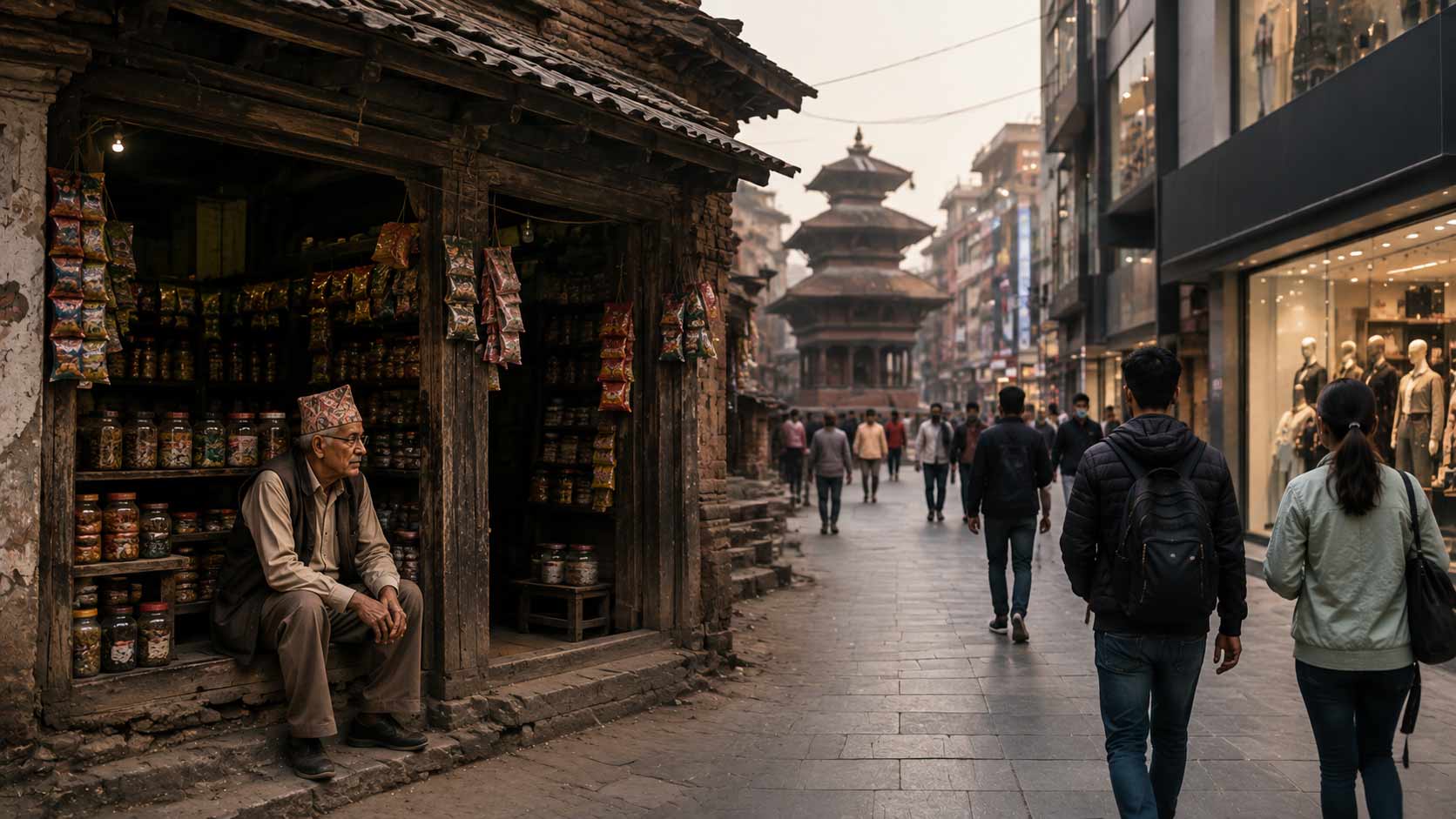
Kathmandu, August 22, 2026 — The small neighborhood shop has long been one of the most familiar parts of everyday life in Nepal. A customer could walk into a local kirana, ask for a packet of noodles, a few kilograms of rice or a bottle of cooking oil, and often buy on credit if the shopkeeper knew the family. The shop was not merely a place to buy goods; it was part of the neighborhood's social and economic fabric.
Today, that model is facing a very different retail environment.
Supermarkets, departmental stores, convenience outlets, digital payments and online shopping have changed how Nepalis buy everyday goods, particularly in urban areas. Yet the available evidence does not show that traditional shops are simply disappearing. Instead, Nepal appears to be experiencing a transition from traditional retail toward a more mixed retail system, in which small shops continue to dominate large parts of the market while modern and digital channels expand.
The scale of traditional retail is still enormous. Nepal's National Economic Census 2018 recorded 498,058 establishments in the wholesale and retail trade sector, including motor trade and repair. Of those, 84.03 percent had only one or two people engaged, while another 13.68 percent had three to five people. Only 0.69 percent had 10 or more people.
That structure is important. Nepal's retail economy has historically been built around thousands of small, owner-operated or family-run businesses rather than large chains. The National Statistics Office's Distributive Trade Survey 2022, which used the 2018 census as its sampling frame, also found that about 88.65 percent of people engaged in wholesale and retail trade were involved in retail trade. Across wholesale and retail trade, 1.13 million people were engaged, with an average of only two people per establishment.