QR payments do not mean a customer has purchased something online. They can be used at physical stores, restaurants, markets and other businesses. But they demonstrate how quickly the traditional cash-based retail experience is changing.
For small shopkeepers, this creates both a challenge and an opportunity.
A traditional shop once competed primarily through location, personal relationships, availability and credit. Now customers increasingly compare prices, search for products online, use digital payments and expect delivery or convenient shopping experiences.
Yet the same technology can help small retailers survive.
An example came during the COVID-19 period, when UNCDF worked with a digital marketplace model connecting local kirana stores with customers ordering everyday necessities. The initiative demonstrated that small stores could be integrated into digital commerce rather than simply displaced by it. One participating shop in Lalitpur, Sita Store, had been operating for 12 years and depended on the shop for more than 60 percent of its total income. The digital platform helped the store continue serving customers during a period when physical retail was severely disrupted.
Other platforms have subsequently attempted to bring small retailers into digital supply chains. Nepal-based B2B platform Pasale, for example, describes its service as a digital marketplace for kirana retailers, allowing them to order stock through a mobile application and obtain wholesale-priced goods without maintaining very large inventories.
This points to a more complicated reality: technology does not necessarily have to kill the neighborhood shop. It can also change the way the shop operates.
The more immediate challenge for many small retailers may be economics.
The National Statistics Office's 2022 Distributive Trade Survey found that the average operating cost per retail establishment was Rs. 219,240 during its reference period. The survey also recorded an average retail trade margin of 18.28 percent across the retail division.
Those figures help explain why a small shop can appear busy without necessarily generating a large profit. A shopkeeper must cover rent, electricity, transport, labor, inventory losses and other operating expenses from the margin earned on sales. If sales volumes are low or customers increasingly shift their larger purchases to supermarkets, the business can become difficult to sustain.
The survey also found that only about one-fifth of people engaged in the wholesale and retail trade sector were paid employees. Average annual wages and salaries per paid employee were Rs. 208,494, or about Rs. 17,374 a month, during the survey's reference period.
This illustrates another defining feature of traditional Nepali retail: many shops depend heavily on the owner's own labor and unpaid family members. A shop may therefore survive not because the formal return on capital is particularly high, but because the family treats the business as both workplace and source of household income.
That makes the question of succession particularly important.
A traditional shop run by a parent may remain profitable enough to support the household, but the children may not want to spend long hours behind a counter for the same return. Younger family members increasingly have access to education, migration and alternative employment. If the next generation does not take over, an established neighborhood shop can disappear even without a supermarket directly forcing it out.
This is one reason it would be premature to describe the situation simply as "traditional shops are dying."
Nepal's official data do not currently provide a clean year-by-year series showing how many traditional kirana shops have closed and how many new ones have opened. The 2022 Distributive Trade Survey itself notes that the previous comparable survey was conducted in 2008, creating a 14-year gap in detailed distributive-trade statistics.
Without a consistent time series specifically tracking kirana stores, it is impossible to establish nationally that traditional shops are disappearing at a particular rate.
What can be established is that Nepal's retail structure is changing.
In the 2018 economic census, wholesale and retail trade accounted for 53.94 percent of establishments across industries and 30.6 percent of persons engaged, making trade the largest category by number of establishments and the largest share of employment among the listed industries.
At the same time, organized retail chains have expanded, e-commerce transactions have grown, digital payments have become widespread and consumer expectations have changed.
The result is not necessarily the disappearance of the neighborhood shop. It is segmentation.
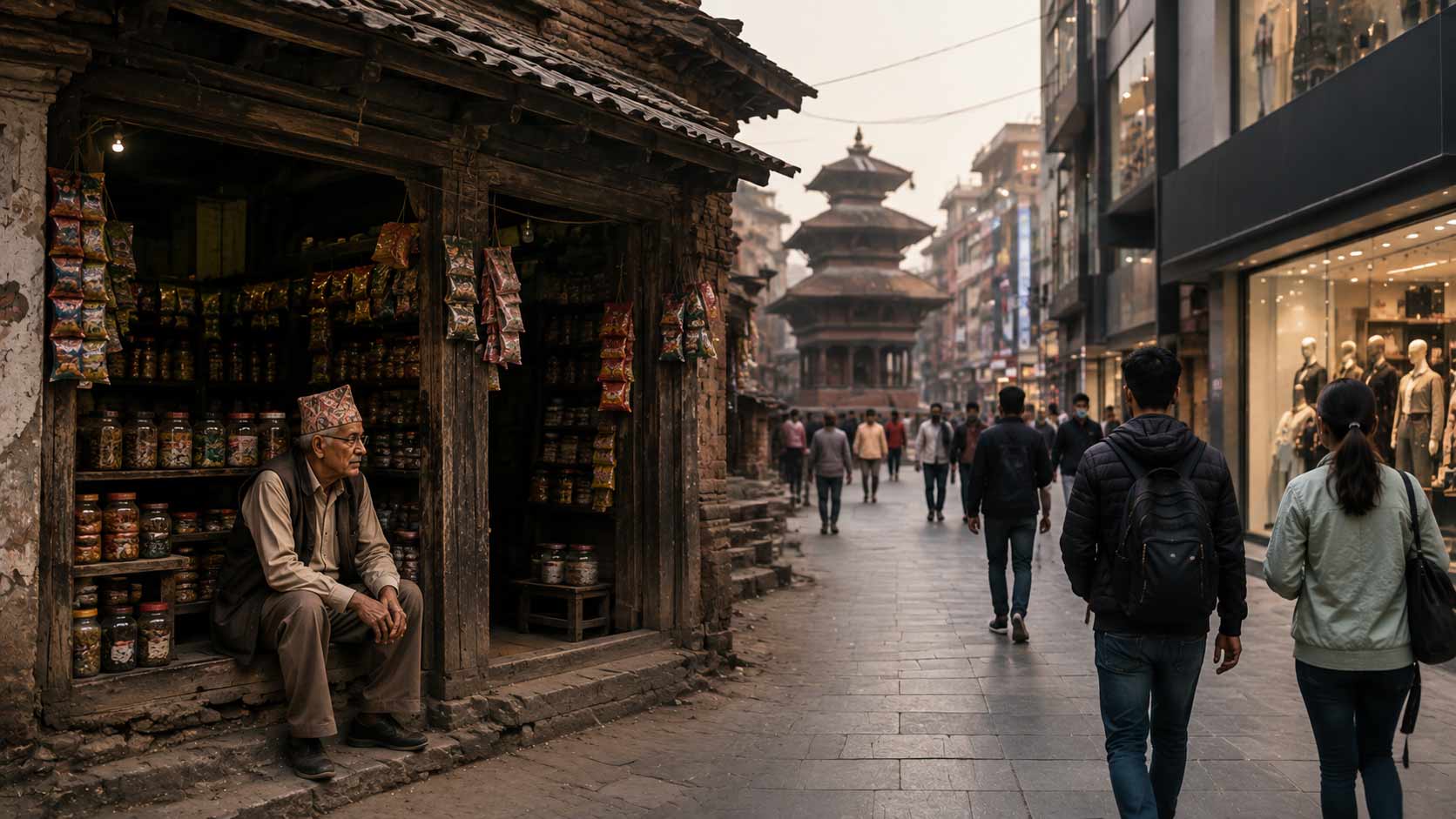
A supermarket may win the monthly grocery trip. An online marketplace may win the purchase of electronics, clothing or household goods. But the neighborhood kirana can still win the customer who needs two packets of noodles, a litre of milk, cigarettes, snacks or cooking ingredients immediately and does not want to travel several kilometers.
The traditional shop also has advantages that large retailers struggle to reproduce.
There is proximity. There is familiarity. There may be informal credit. A shopkeeper may know which brand a customer normally buys, remember a family's preferences or allow a regular customer to pay later. In neighborhoods where customers need small quantities rather than bulk purchases, these relationships can matter.
Rural and less densely served areas provide another layer of protection. Online commerce requires connectivity, logistics and reliable delivery, while large supermarkets need sufficient population density and purchasing power to justify their locations. The US Department of Commerce notes that online activity in Nepal remains concentrated in Kathmandu and several other cities, with relatively limited penetration in remote areas.
That means the future of the traditional shop is likely to differ sharply between Kathmandu and a rural municipality.
In Kathmandu, a small retailer may increasingly need to compete with supermarkets, convenience stores, food-delivery platforms and online sellers. In a rural community, the same type of shop may remain the most practical retail option because of proximity and limited alternatives.
The traditional shop is also becoming more digital itself.
A QR code taped beside a cash drawer may look like a small change, but it represents a significant shift in how Nepal's small businesses interact with customers. A shopkeeper can now accept digital payments without installing a conventional point-of-sale system. Some can use social media to display products, messaging applications to receive orders and delivery services to reach customers outside their immediate neighborhood.
In that sense, the traditional Nepali shop may not be disappearing as much as it is being forced to evolve.
The real threat may be to the old business model rather than to the physical shop itself.
A shop that relies entirely on walk-in customers, maintains little inventory information, accepts only cash and cannot compete on price may struggle increasingly against organized retailers and digital platforms. A shop that combines neighborhood convenience with QR payments, phone orders, home delivery, better inventory management and competitive sourcing can remain relevant.
The future may therefore belong neither entirely to the supermarket nor entirely to the traditional kirana.
It may belong to the retailer that can combine the strengths of both: the convenience and personal trust of the neighborhood shop with the pricing, technology, product availability and efficiency associated with modern retail.
For now, the evidence does not justify saying that Nepal's traditional shops are disappearing. There is something more interesting happening. The shop is changing, the customer is changing and the definition of retail itself is changing.
The small counter, the handwritten credit notebook and the familiar shopkeeper may still have a place in Nepal's future. But increasingly, that shop may also have a QR code, a mobile phone for orders, digital inventory and a customer who expects the same convenience that a supermarket or online marketplace provides.
The traditional Nepali shop may survive—not by remaining traditional, but by becoming something new.